Posts

Every week, Tuesday to Friday.

Cash, partners and succession, in the companies of those who sign. The same posts as on LinkedIn, in full, with the image or the carousel, translated from Portuguese.

Follow on LinkedIn

Jun 29, 2026

You're not stuck because you lack the answer. You're stuck because you're alone with it


image 1/9image 2/9image 3/9image 4/9image 5/9image 6/9image 7/9image 8/9image 9/9
1 / 9

You're not stuck because you lack the answer. You're stuck because you're alone with it.

Most people confuse deciding alone with strength. I used to confuse it too. Alone, you're not freer. You're more exposed.

My first instructor, Delania Santos, saw what I couldn't: the answer was already mine, I just lacked the tool to apply it. She didn't give me what I didn't have. She cleared the one thing blocking me: the lack of clarity about what I already knew.

At your worst moment, survival mode kicks in and whoever should confront you disappears. That's when the decision gets expensive. Not from lack of information, but from too much proximity to your own problem. That distance is what you buy with real Strategic Advisory, when it becomes practice and not decoration on the org chart.

The blind spot doesn't disappear because you're smart. It disappears because someone outside can see it.

Everyone gets stuck in the same fight. The difference is who you put beside you before the market sends the bill.
Post page · Comment on LinkedIn

Jun 26, 2026

The most expensive decision in your company is not the wrong one. It is the one you never close

image 1/11image 2/11image 3/11image 4/11image 5/11image 6/11image 7/11image 8/11image 9/11image 10/11image 11/11
1 / 11

The most expensive decision in your company is not the wrong one. It is the one you never close.

I spent the whole week working on strategy.

Most companies have no strategy. And it is not for lack of capability. It is a mix of not knowing, not wanting, and the comfort of waking up, going to work and living whatever day shows up. Without looking ahead. Without thinking about next year.

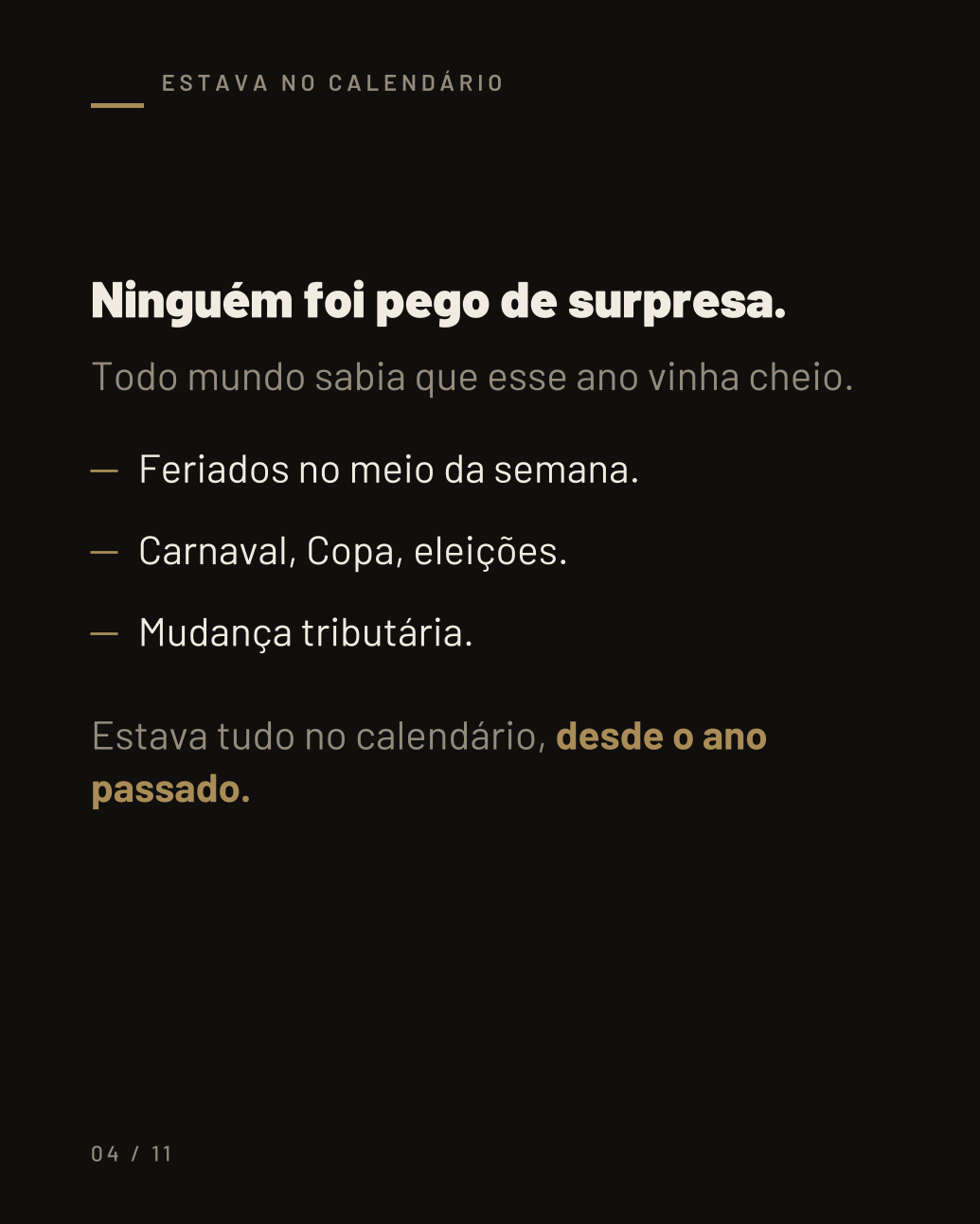
The most uncomfortable part is that nobody was caught by surprise. Everyone knew this year would be packed. Midweek holidays, Carnival, the World Cup, elections, tax change. It was all on the calendar, in plain sight, since last year. The only question is whether you organized yourself for it, or just let the year happen to you.

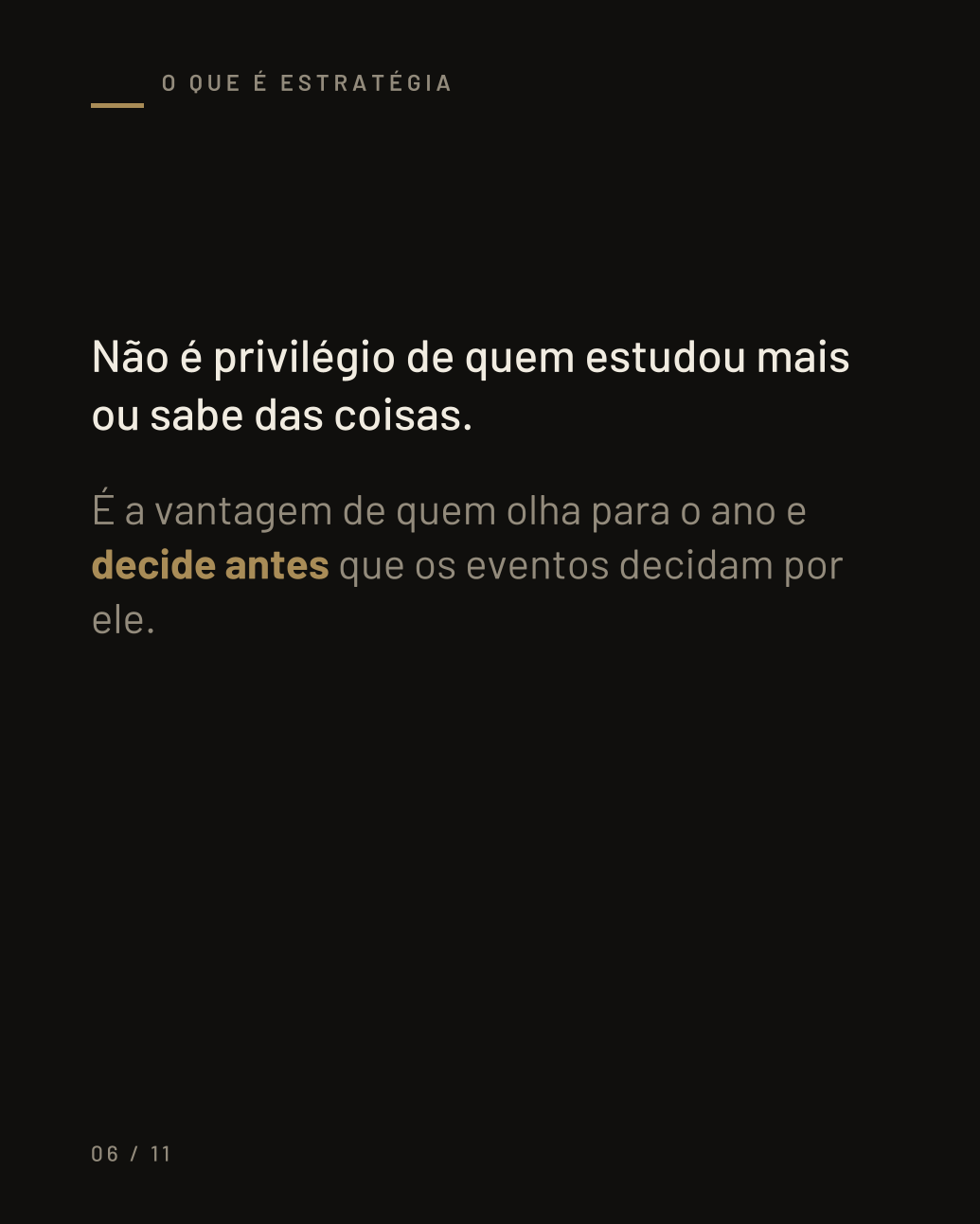
Because strategy is not a privilege of those who studied more or know more. It is the advantage of whoever looks at the whole year and decides, in advance, what to do so these events do not decide for him. That is where real Business Strategy comes in: the year working for you, not against you.

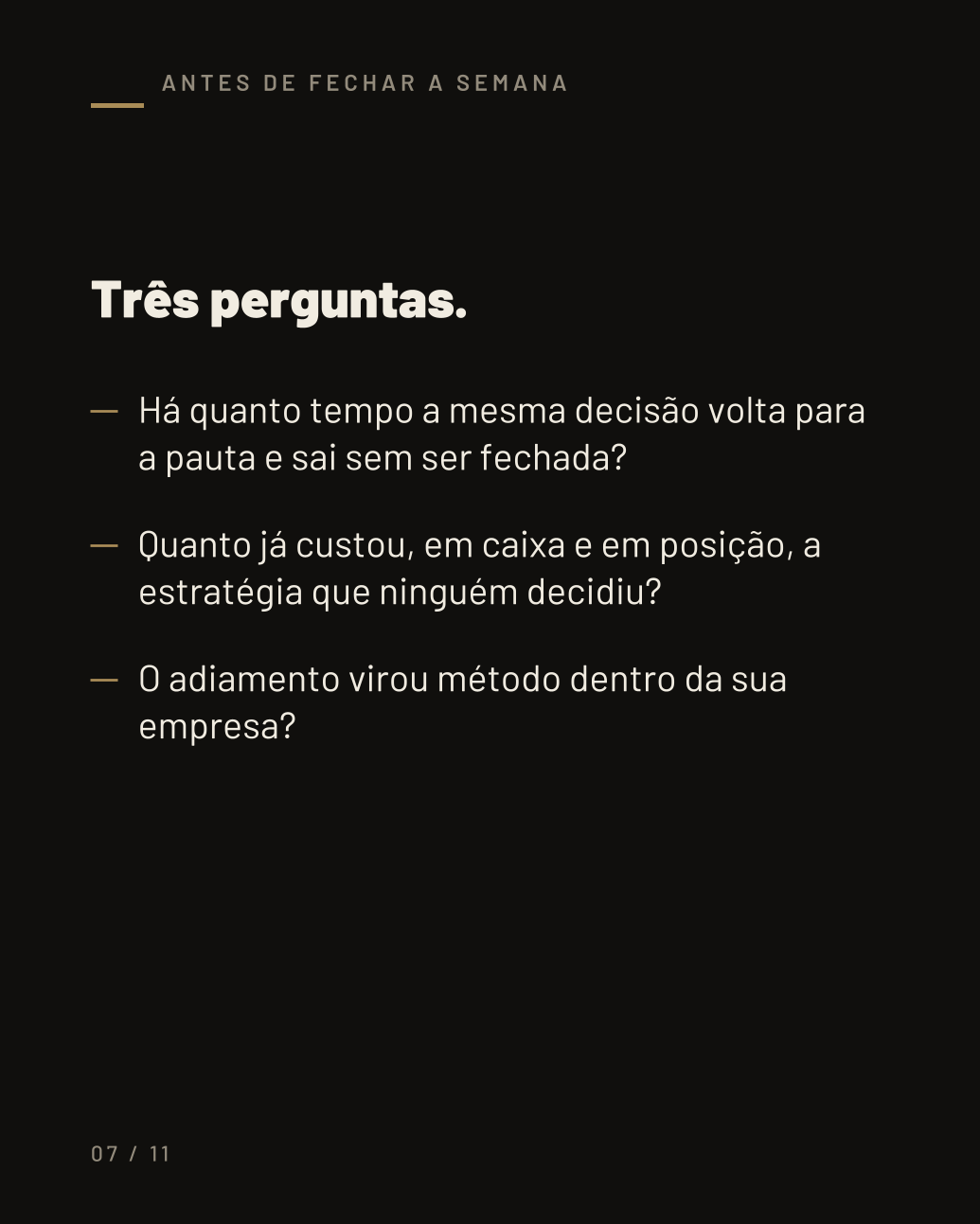
Before closing the week, three questions:

• How long has the same decision been coming back to the agenda and leaving without being closed?
• How much has the strategy nobody decided already cost, in cash and in position?
• Has postponement become the way your company works?

Every day you push it back seems free. At the end of the year, it becomes the sum of all the decisions you did not make.

A wrong decision can be corrected. A postponed decision comes with an invoice. And the invoice is always bigger.

That invoice does not wait for the December balance sheet. Every quarter you postpone comes out of your margin, and does not come back.

There is no recommendation. There is a decision.

Post page · Comment on LinkedIn

Jun 25, 2026

The biggest risk to your strategy is not that it is wrong. It is that it worked

image 1/9image 2/9image 3/9image 4/9image 5/9image 6/9image 7/9image 8/9image 9/9
1 / 9

The biggest risk to your strategy is not that it is wrong. It is that it worked.

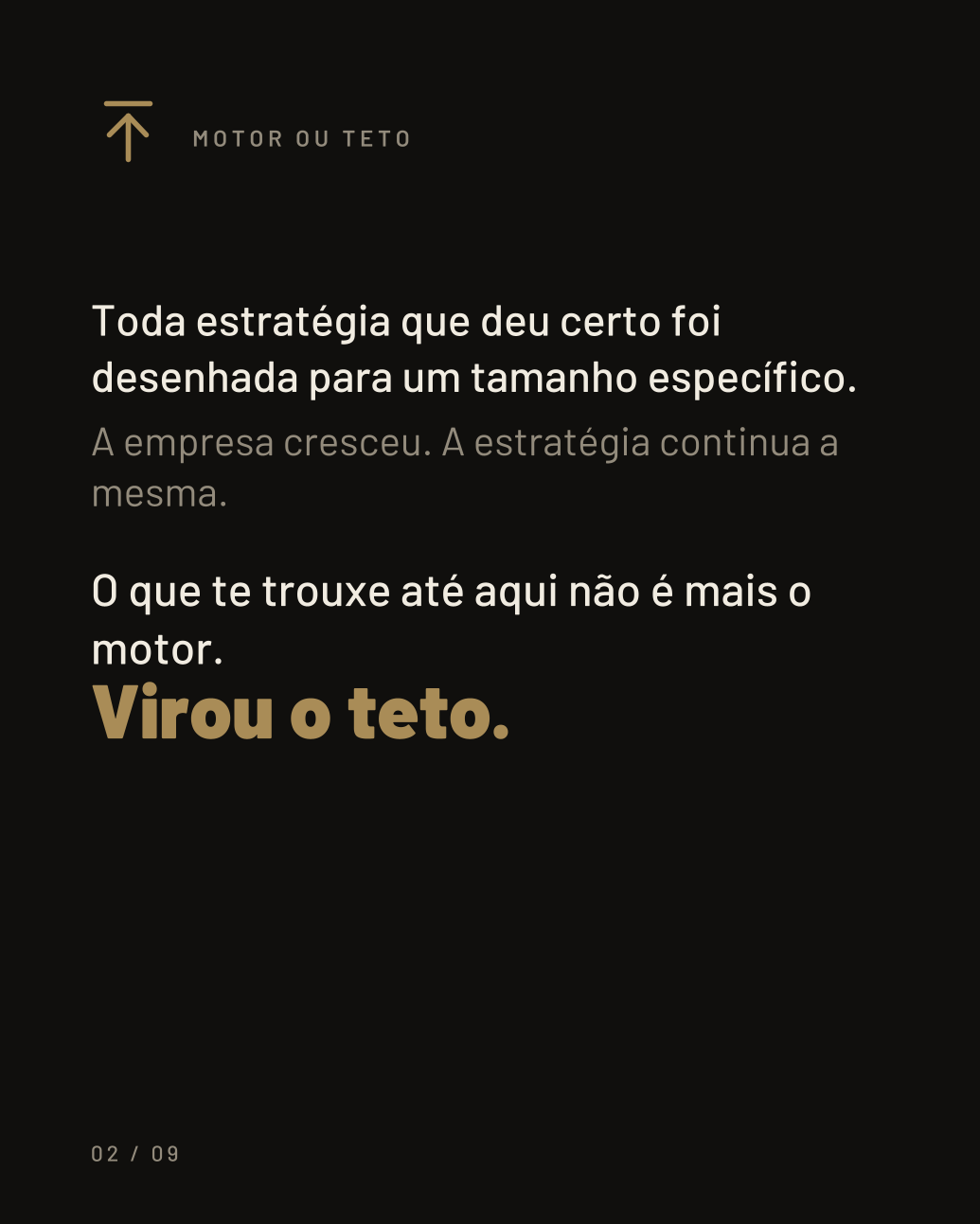
Every strategy that worked was designed for a specific company size. The problem shows up later: the company grew, and the strategy stayed the same. What brought you here was designed for the operation of three years ago. Today it is no longer the engine. It has become the ceiling.

Updating the plan sounds like a year-end chore. In practice, it is what keeps Business Strategy tied to the company's real size, not to what it used to be. And that update needs to flow through the entire structure. Strategy that stays only in the owner's head does not become direction, it becomes noise, with each area rowing in a different direction.

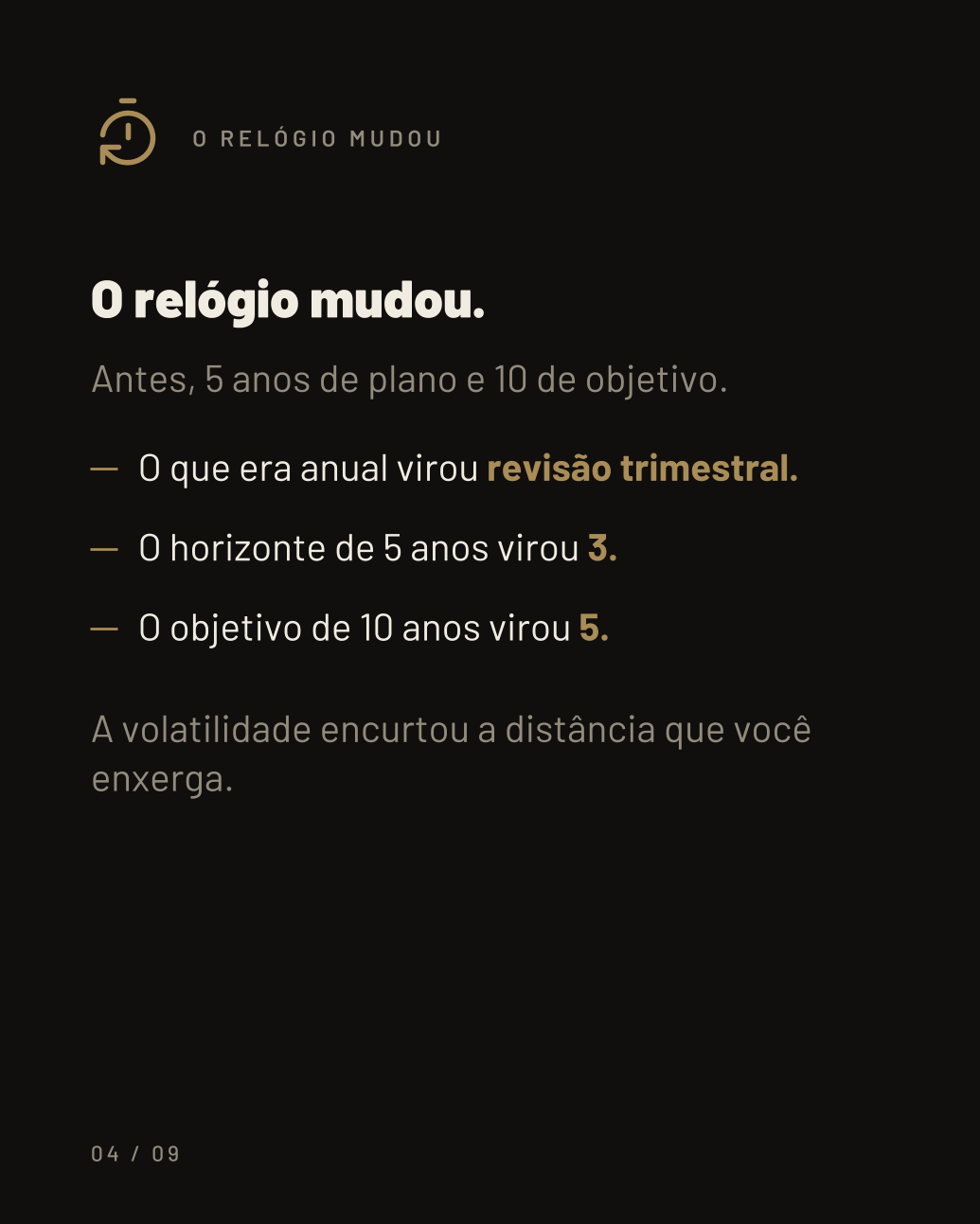
The clock changed too. Before, 5-year planning and a 10-year goal. Today that mechanism broke. What was annual became a quarterly review. The 5-year horizon became 3. The 10-year became 5. Not because the long term stopped mattering, but because volatility shortened the distance you can see.

That is why today I work much closer to the operation. From far away, context slips through, and strategy arrives late.

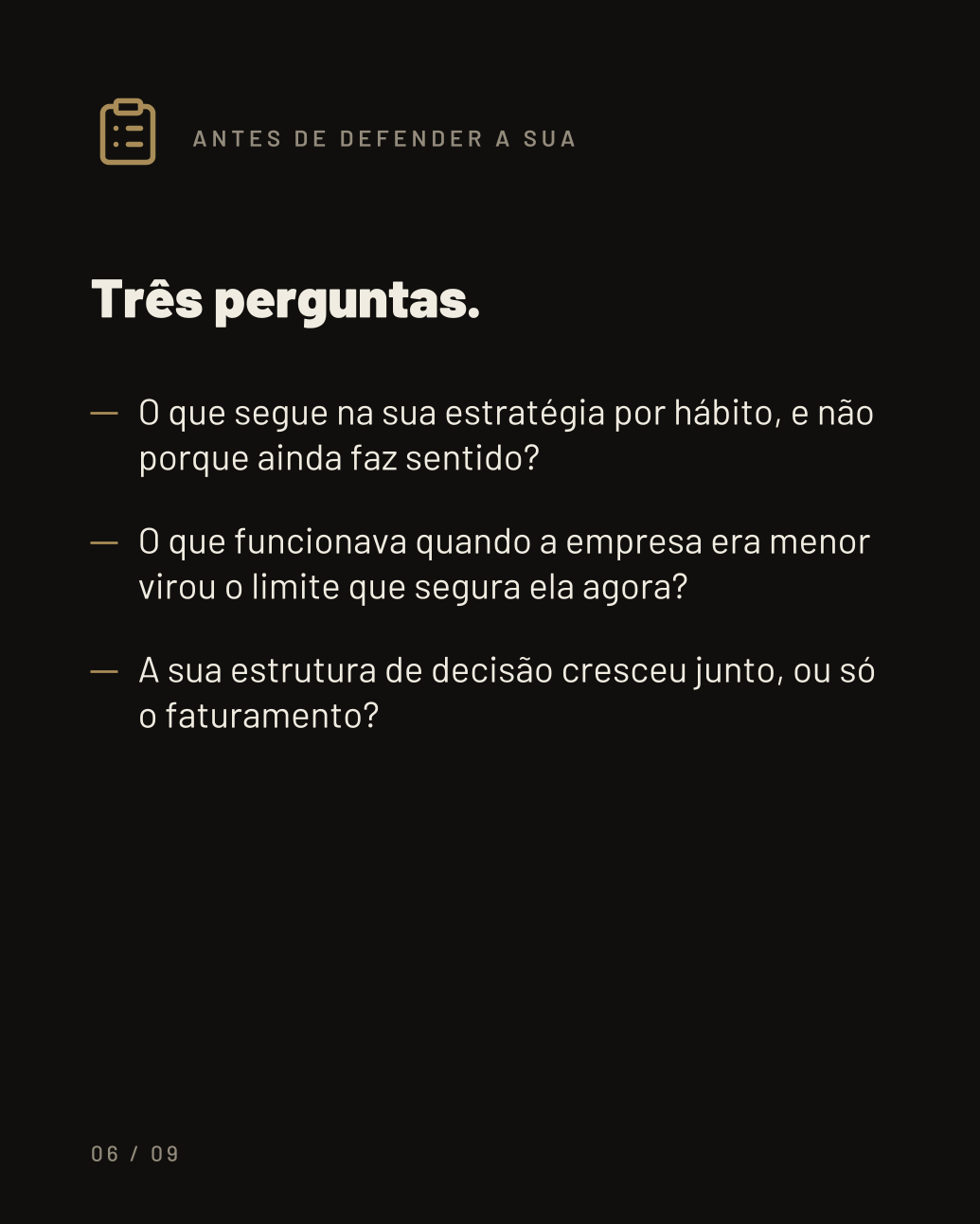
Before defending yours, three questions:

• What stays in your strategy out of habit, and not because it still makes sense?
• Has what worked when the company was smaller become the limit holding it back now?
• Did your decision structure grow too, or only revenue?

No strategy ages on its own. It ages at exactly the speed your company grows.

What brought you here is not what will take you further. It is exactly what is holding you back.

And the size you want next year is already being decided by today's strategy.

Post page · Comment on LinkedIn

Jun 25, 2026

My main training had no diploma

My main training had no diploma.
It had grease.

Before the positions, the Boards, the international negotiations and the M&A, there was a repair shop floor.

That is where I learned one of the hardest truths about family businesses: a surname opens the conversation, but it does not sustain authority.

At 22, to build a repair shop inside the largest tire shop in the Northeast, I had to convince my own grandfather. And, precisely because I was family, there was no room for improvisation.

I had to show up with numbers.
With a thesis.
With evidence.
With execution.

That is where some of the strengths I still carry were born: proving with data, turning operations into scale, negotiating without destroying value, standardizing processes and building companies that can run without depending on a single person.

Then came courses, Boards, energy, São Paulo, China, Europe, M&A, governance and family businesses.

But the origin was something else.

The origin was learning that strategic clarity is not born in speeches.
It is born when you have to solve a real problem, with real people, real customers, real pressure and real margin.

Authority is not inherited.
It is demonstrated.

Post page · Comment on LinkedIn

Jun 24, 2026

The move that got ahead of you was not brilliant. It was yours. You just did not execute it first

image 1/10image 2/10image 3/10image 4/10image 5/10image 6/10image 7/10image 8/10image 9/10image 10/10
1 / 10

The move that got ahead of you was not brilliant. It was yours. You just did not execute it first.

When I set up one of my companies, I drew up a robust plan. Every line, every phase, everything mapped before starting. But capital was limited. So I executed in stages, and everything was running as planned.

What I did not factor in was the competitor. Same idea, same design, almost a copy of my plan. The difference is that, for him, capital was not a problem. While I advanced in phases, he executed the whole plan at once.

That is the uncomfortable truth of the market: the strategic paths are almost all the same. You and your competitor see the same routes. What separates the two is not the idea. It is the speed of execution and the speed of decision. That is where Business Strategy stops being planning and becomes who gets there first.

In my case, it was not a lack of decision. It was not being able to execute 100% of the plan at once. I decided. I just did not have the capital to run at the same speed.

Today, looking at other companies, I see a different problem. And a worse one. It is not capital. It is decision. Owners who, afraid of too many variables, do not take the risk. And fall behind without understanding why.

The questions that separate those who lead from those who chase:
• The move your competitor made this week, how long had it been sitting on your desk?
• The strategy you did not decide, has the market already decided it for you?
• Who is testing in practice the hypothesis you are still debating in meetings?

The problem was never a lack of clarity. It was turning clarity into postponement.

There is no postponed strategy. There is strategy the market executed without you.

And it did not wait for you to decide before it started.

Post page · Comment on LinkedIn

Jun 23, 2026

Almost every strategy meeting is, deep down, discussing execution

image 1/10image 2/10image 3/10image 4/10image 5/10image 6/10image 7/10image 8/10image 9/10image 10/10
1 / 10

Almost every meeting called strategy is, deep down, discussing execution.

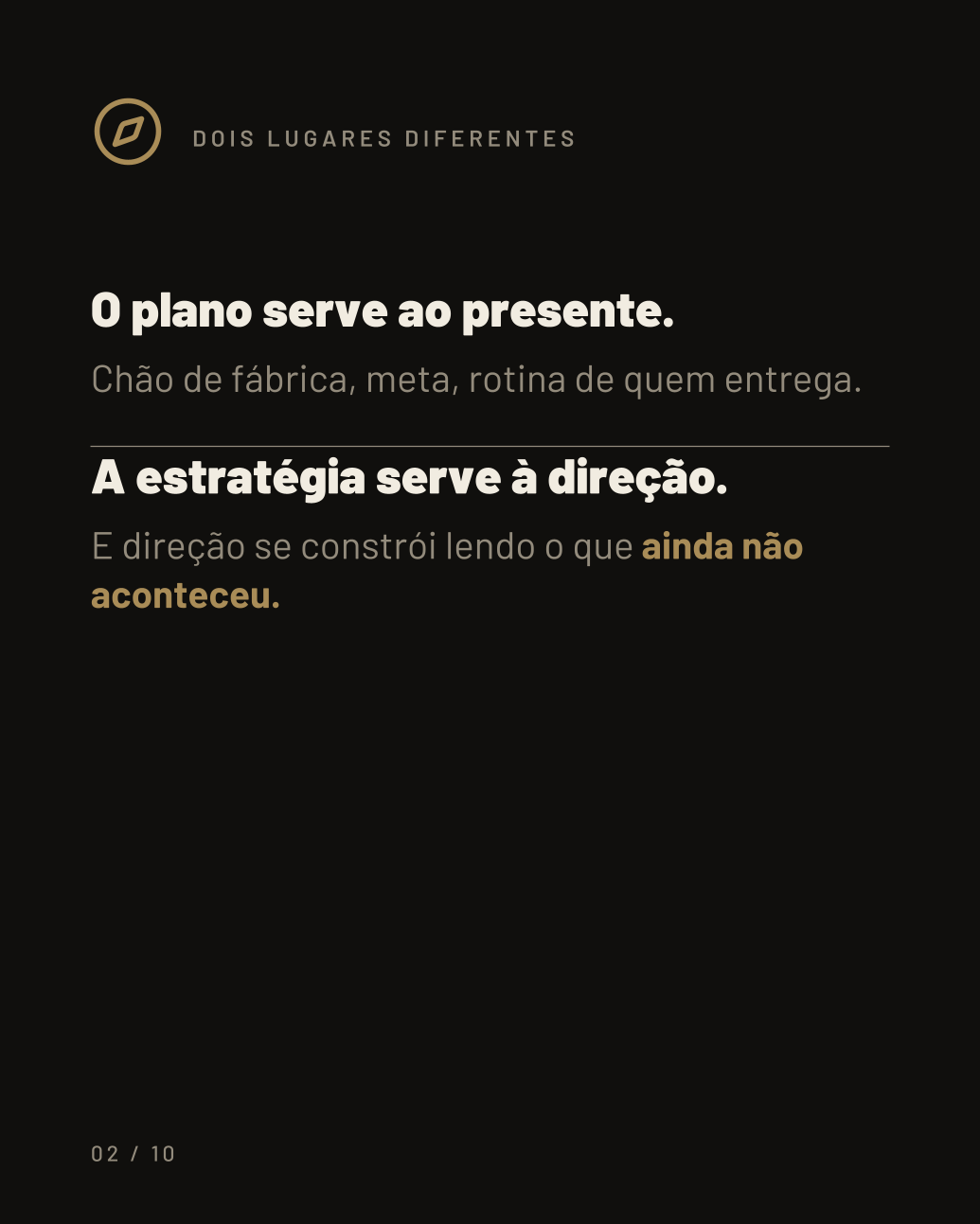
An action plan and a strategy do not occupy the same place. The plan serves the present: the shop floor, the target, the routine of those who execute. Strategy serves direction, and direction is only built by reading what has not happened yet: politics, the economy, the next move of whoever regulates your sector. That is where real Business Strategy comes in, the difference between anticipating the scenario and chasing it afterwards.

In Corporate Governance work, what I see most is last year's plan running in a world that has already changed the subject.

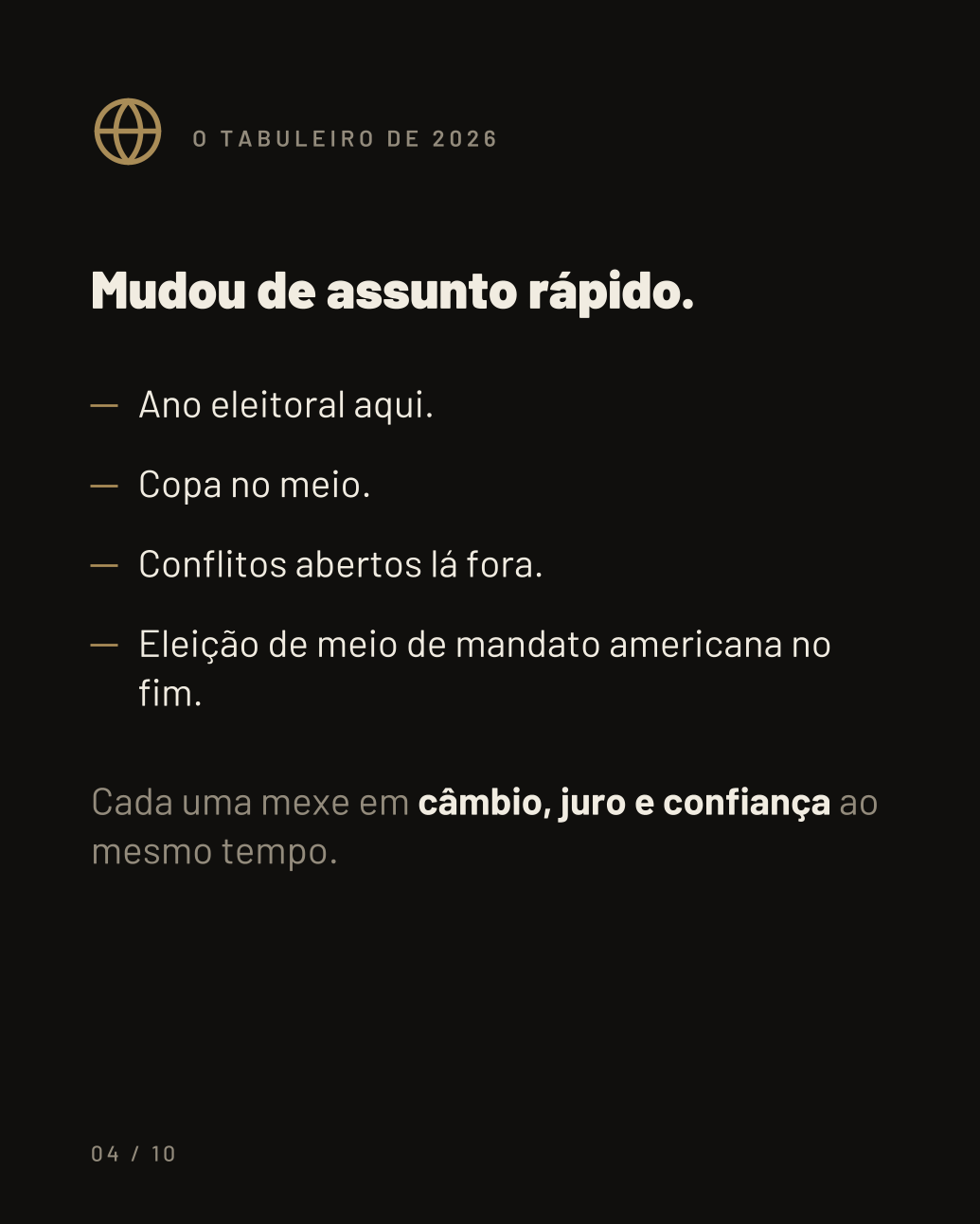
And 2026 changed the subject fast. An election year here, the World Cup in the middle, open conflicts abroad, the American midterm election at the end. Each of these pieces moves exchange rates, interest rates and confidence at the same time. Your strategy needs to be the sharpest you have ever drawn. Not the one that was finished and never touched again.

Before defending yours, answer four questions:
• Are you reviewing the strategy, or just updating the schedule of those who execute?
• How many real alternatives reached the table before the one you settled on?
• Is there an obvious move nobody proposes, just to avoid being the first to own it?
• Do you have a route for year 0, year 3 and year 5, or does the plan end at the next close?

A strategy nobody reviews does not age slowly. It ages from one election to the next.

Whoever corrects course only when the scare arrives is not deciding. He is betting.

And the year that will collect this bill has already begun.

Post page · Comment on LinkedIn

Jun 22, 2026

I entered the best market for someone like me. And the worst, at the same time

image 1/11image 2/11image 3/11image 4/11image 5/11image 6/11image 7/11image 8/11image 9/11image 10/11image 11/11
1 / 11

I entered the best market for someone like me. And the worst, at the same time.

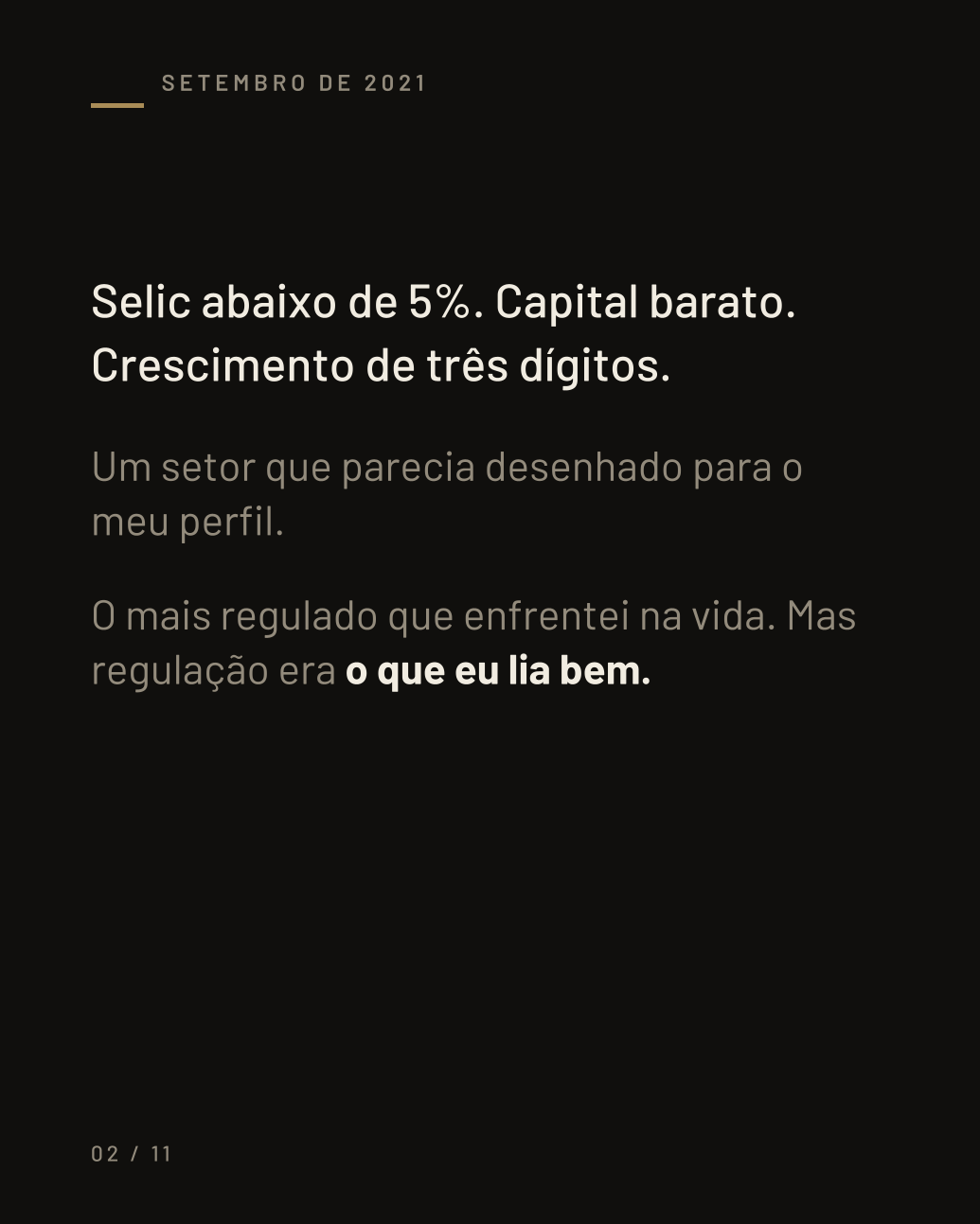
September 2021. Brazil's Selic rate below 5%, cheap capital, triple-digit growth, a sector that seemed designed for my profile. The most regulated one I have faced in my life, but regulation was exactly what I read well. I arrived, executed, delivered results. Everything was right.
And that was exactly when I made my biggest mistake: confusing the market I had understood with the market that existed.

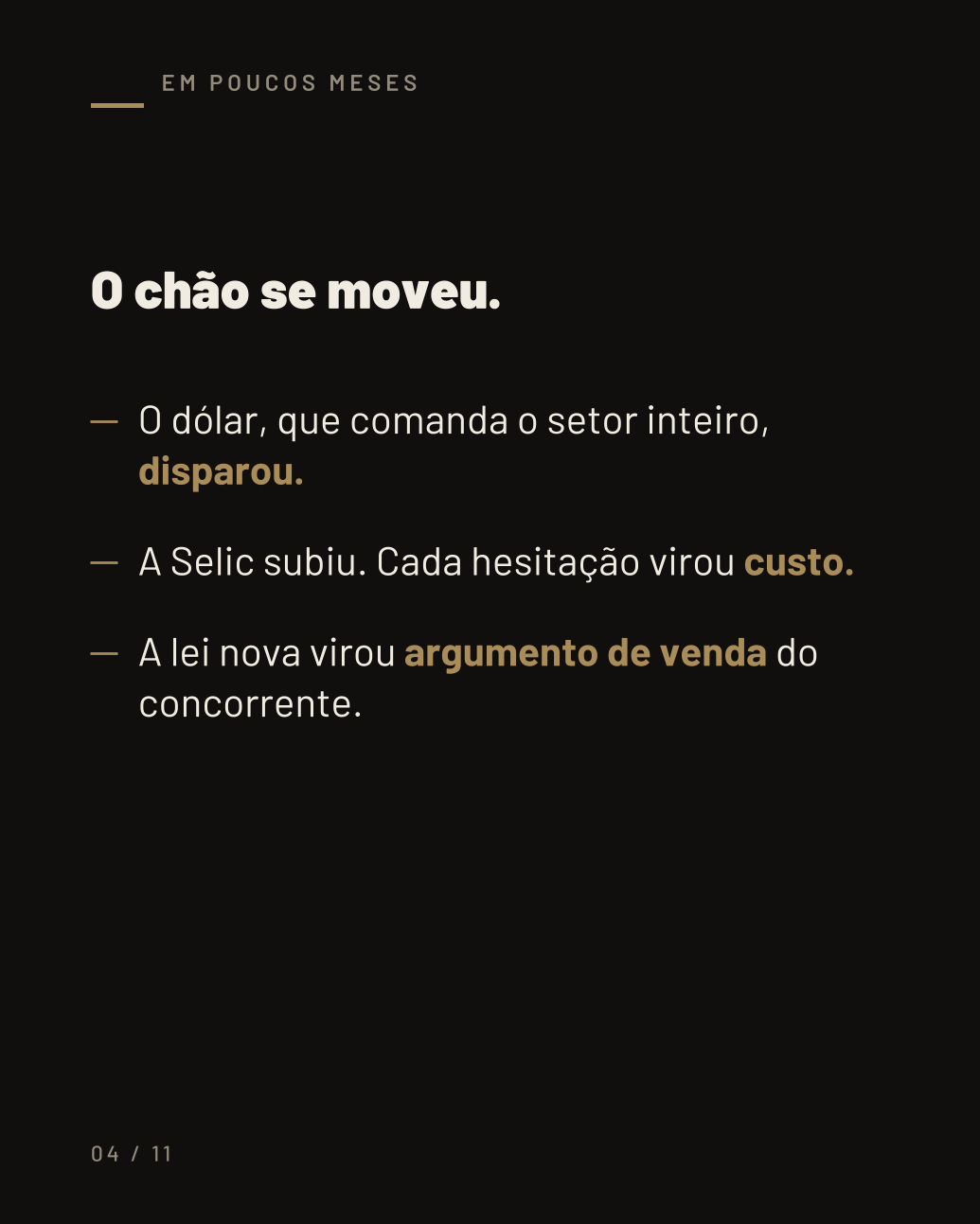
In a few months the ground moved. The dollar, the currency that commands the entire sector, shot up. The Selic rose and turned every hesitation into cost. A new law approved for 2023 came into play, and the fear of it became a competitor's sales pitch.

The plan I had was not wrong. It was old. Old within months. The market did not wait for me to finish executing before changing the rules.

So strategic planning stopped being annual and became quarterly. Three months to read the new scenario, design the response and execute before it expired. Five versions in a single year, when Trump came in and geopolitics took the helm of the sector.

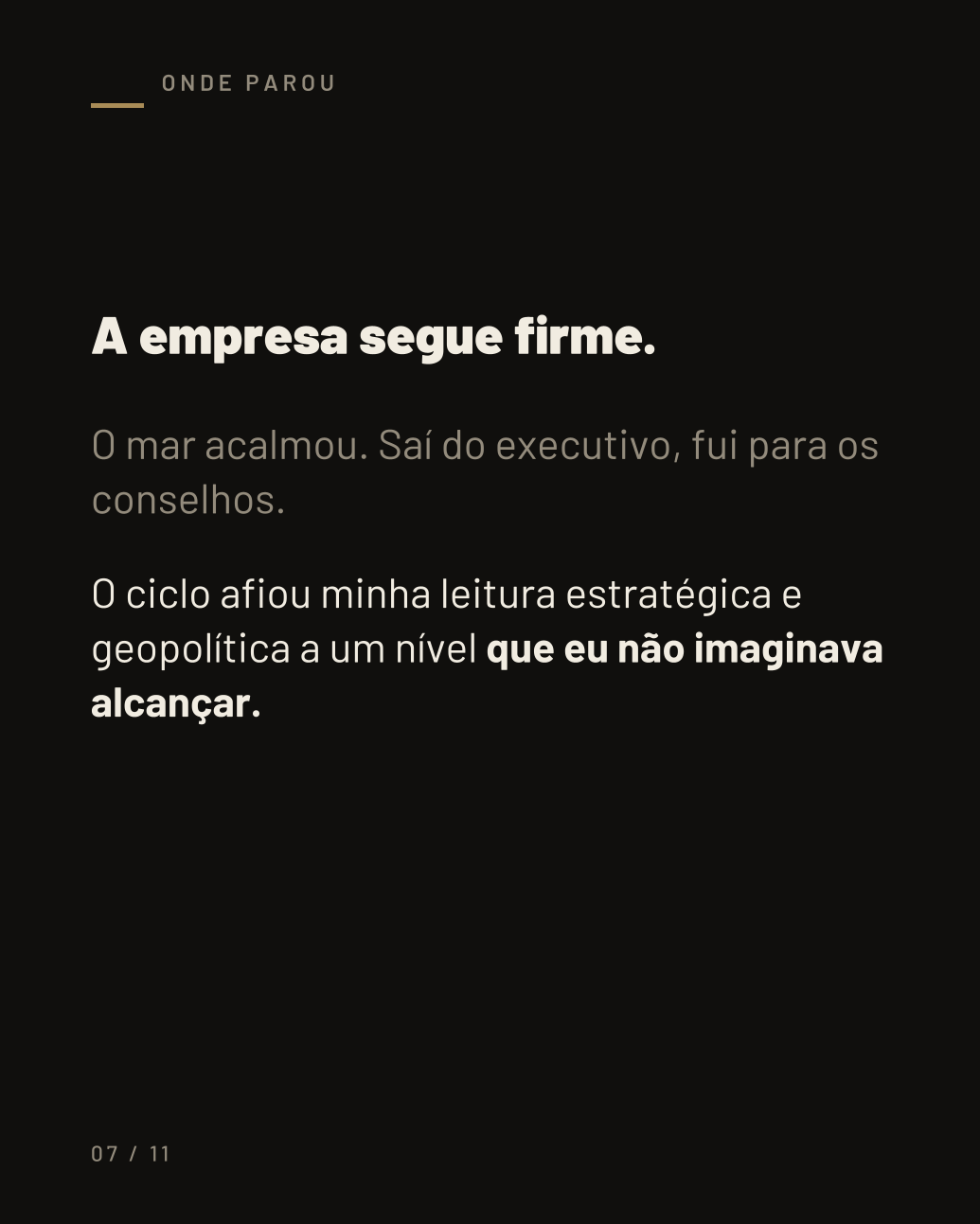
The company remains solid. The sea calmed down, I left the executive role and dedicated myself to Boards. That cycle sharpened my strategic and geopolitical reading to a level I never imagined reaching.

Now turn it inward.

• Is what runs today your decision, or an inheritance nobody had the courage to touch?
• What changed in the last twelve months that your plan still pretends not to see?
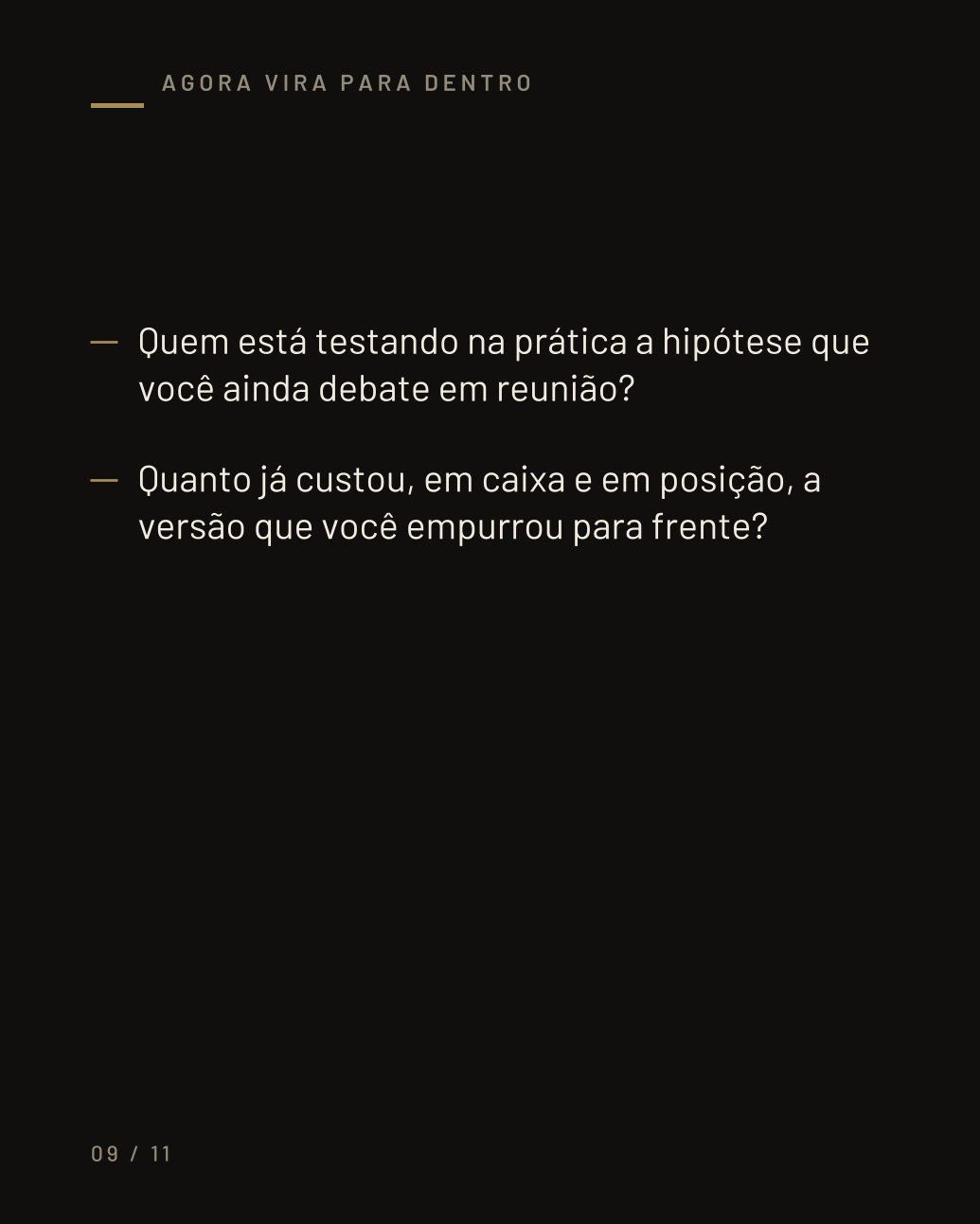
• Who is testing in practice the hypothesis you are still debating in meetings?
• How much has the version you pushed to next quarter already cost, in cash and in position?

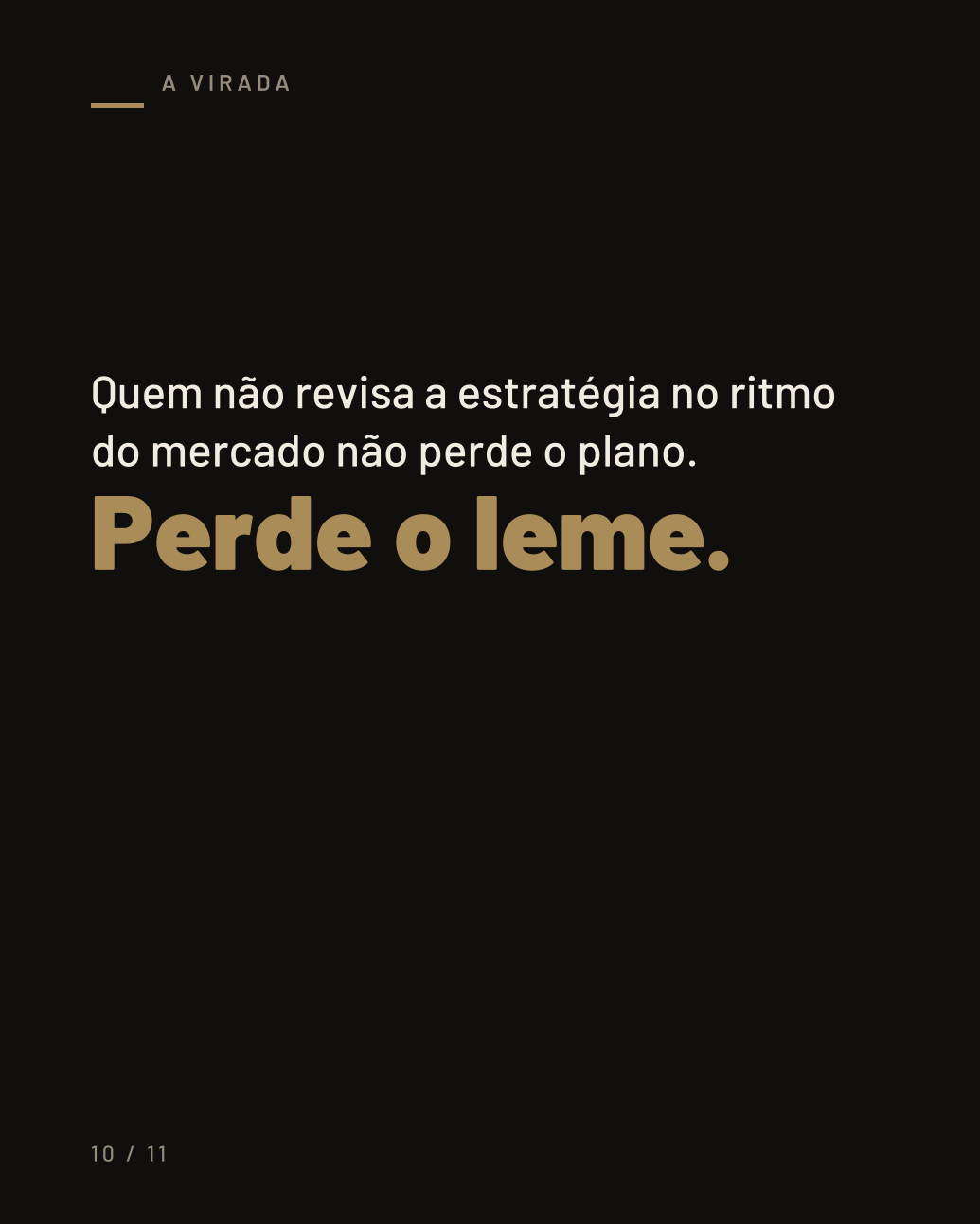
Whoever does not review strategy at the market's pace does not lose the plan. He loses the helm.

Who rules your company: chance or you?

Post page · Comment on LinkedIn

Jun 19, 2026

Not deciding costs more than deciding wrong

image 1/10image 2/10image 3/10image 4/10image 5/10image 6/10image 7/10image 8/10image 9/10image 10/10
1 / 10

Not deciding costs more than deciding wrong.

There is a moment that shows up in no report. The problem has already been identified. Leadership already knows. Everyone at the table recognizes it. And the decision does not come.

While it does not come, the cost grows. Invisible, a little bigger every day.

Analysis is not what is missing. The diagnosis has been done. What remains open is the decision. And postponing what is already clear has a price:

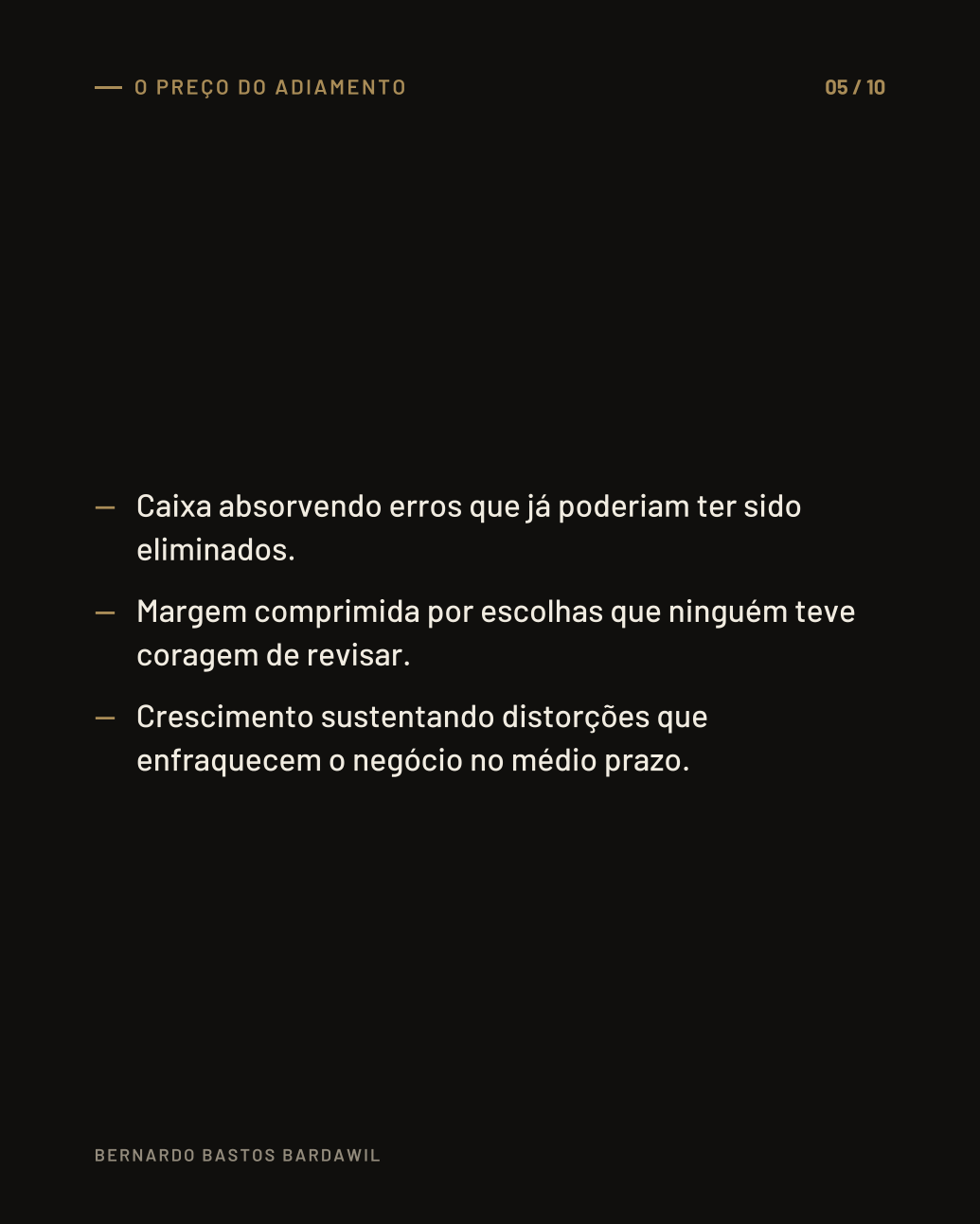
• Cash absorbing errors that could already have been eliminated.
• Margin squeezed by choices nobody had the courage to revisit.
• Growth sustaining distortions that weaken the business in the medium term.

This is not a lack of capability. It is tolerance for what should already have been corrected.

The whole week was about the market. Knowing yours, reading the competitor, seeing the external forces. All of that is clarity. And no amount of clarity replaces a decision.

The question is not what you still need to understand. It is what you have already understood, and keep postponing.

The cost does not wait for your decision. It has already started.

Post page · Comment on LinkedIn

Jun 17, 2026

Your competitor is your best source of analysis. And you ignore it

image 1/11image 2/11image 3/11image 4/11image 5/11image 6/11image 7/11image 8/11image 9/11image 10/11image 11/11
1 / 11

Your competitor is your best source of analysis. And you ignore it.

When he improves, he is telling you something simple: he has started to leave you behind. But ego does not accept learning from whoever it decided to call a rival.
In the past, I made an unusual decision. I was a target for competitors, and every time they needed room, I lost. That is when I created a training center open to everyone, not just to me.
Instead of letting them pull me down, I started leveling the competition upward.

When you raise the game, the market's standard becomes you. And whoever sets the standard does not chase it.

So there is only one question, and it has no middle ground:
• Are you pulling the market down to survive a little longer?
• Are you being pulled, and calling it unfair competition?
• Or are you stuck in time, thinking that is stability?

Whoever seeks to follow a standard lives one step behind. Whoever seeks to be the best becomes the standard.

The market does not belong to those who keep up. It belongs to those who force everyone else to keep up.

Post page · Comment on LinkedIn

Jun 16, 2026

Do you know why your customer stopped coming into your store?

image 1/11image 2/11image 3/11image 4/11image 5/11image 6/11image 7/11image 8/11image 9/11image 10/11image 11/11
1 / 11

Do you know why your customer stopped coming into your store?

Maybe he went to the competitor. Lower price, better service, closer to home. Or maybe you do not even know.

Looking sideways, we get stuck on the neighbor's lawn. And forget to look at the street. Inside every car going by is one of your customers, deciding where to spend.

The annoying part to hear is this: today your biggest competitor may not sell anything you sell. It may be Disney. It may be Dubai.
Information became too accessible, and so did distraction. And purchasing power shrank. Before walking into your store, the customer has already decided where to allocate the money. Without relevance, you do not make the list.

The household that had two cars started sharing one and calling an Uber. At the end of the year, what is left goes to travel.
Your customer does not choose between you and the competitor. He chooses where the money goes furthest.
And the ruler for that choice is not in your sector.

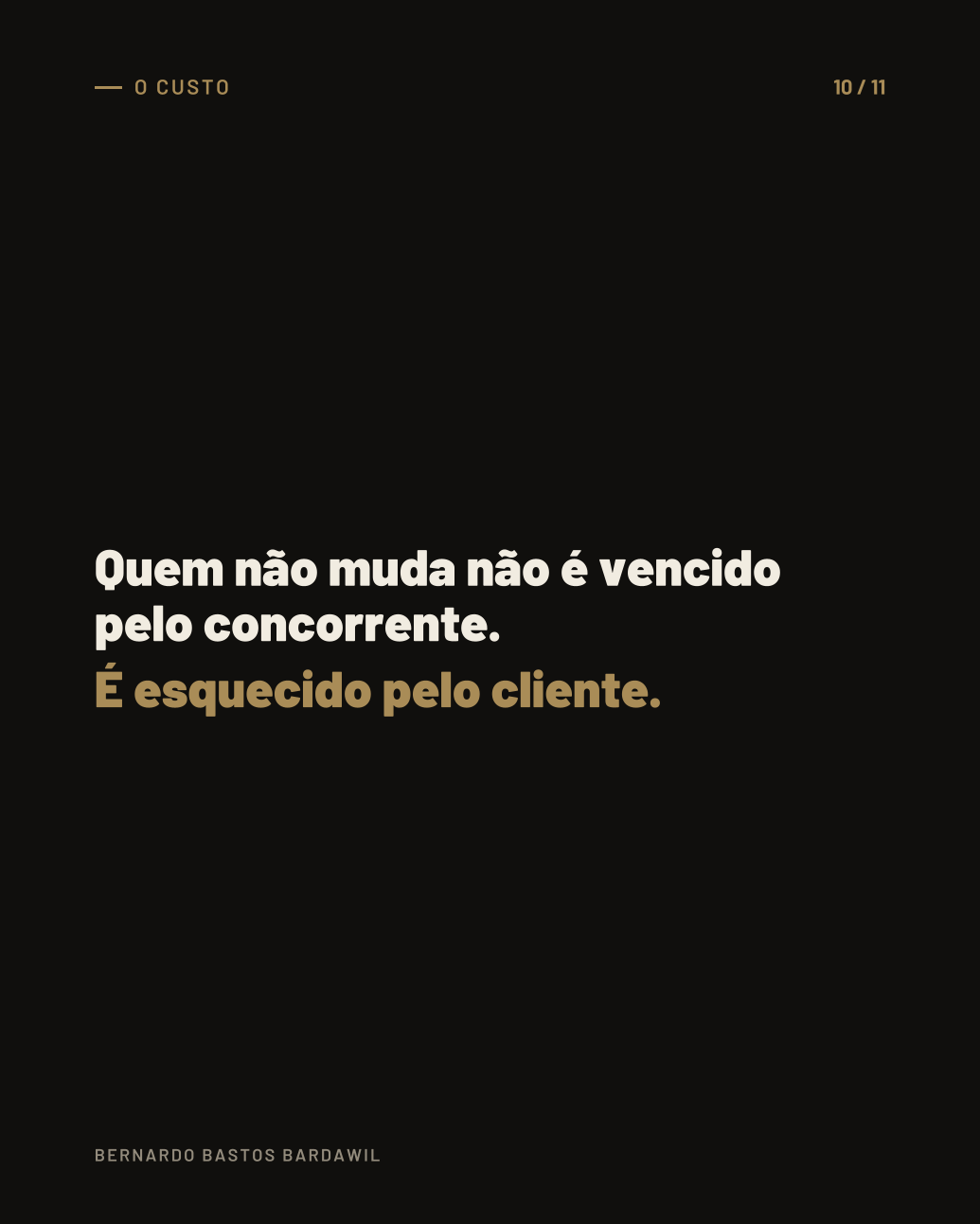
Whoever does not change with it is not beaten by the competitor. He is forgotten by the customer.

Post page · Comment on LinkedIn

Jun 15, 2026

You do not know your market. You know the routine you built inside it

image 1/11image 2/11image 3/11image 4/11image 5/11image 6/11image 7/11image 8/11image 9/11image 10/11image 11/11
1 / 11

You do not know your market. You know the routine you built inside it.

When you opened, you studied everything. Location, competitors, suppliers, margin. You did it with the care of someone who wanted to be the best in the region.

Then day to day arrived. The study became memory, memory became certainty, and you stopped looking because you think you already looked.

But the market is a river. The water you mapped yesterday is not the water running today. And your growth strategy is still the one from the day the dream was new.

Revenue is not reading the market. It is the anesthetic that makes you stop reading.

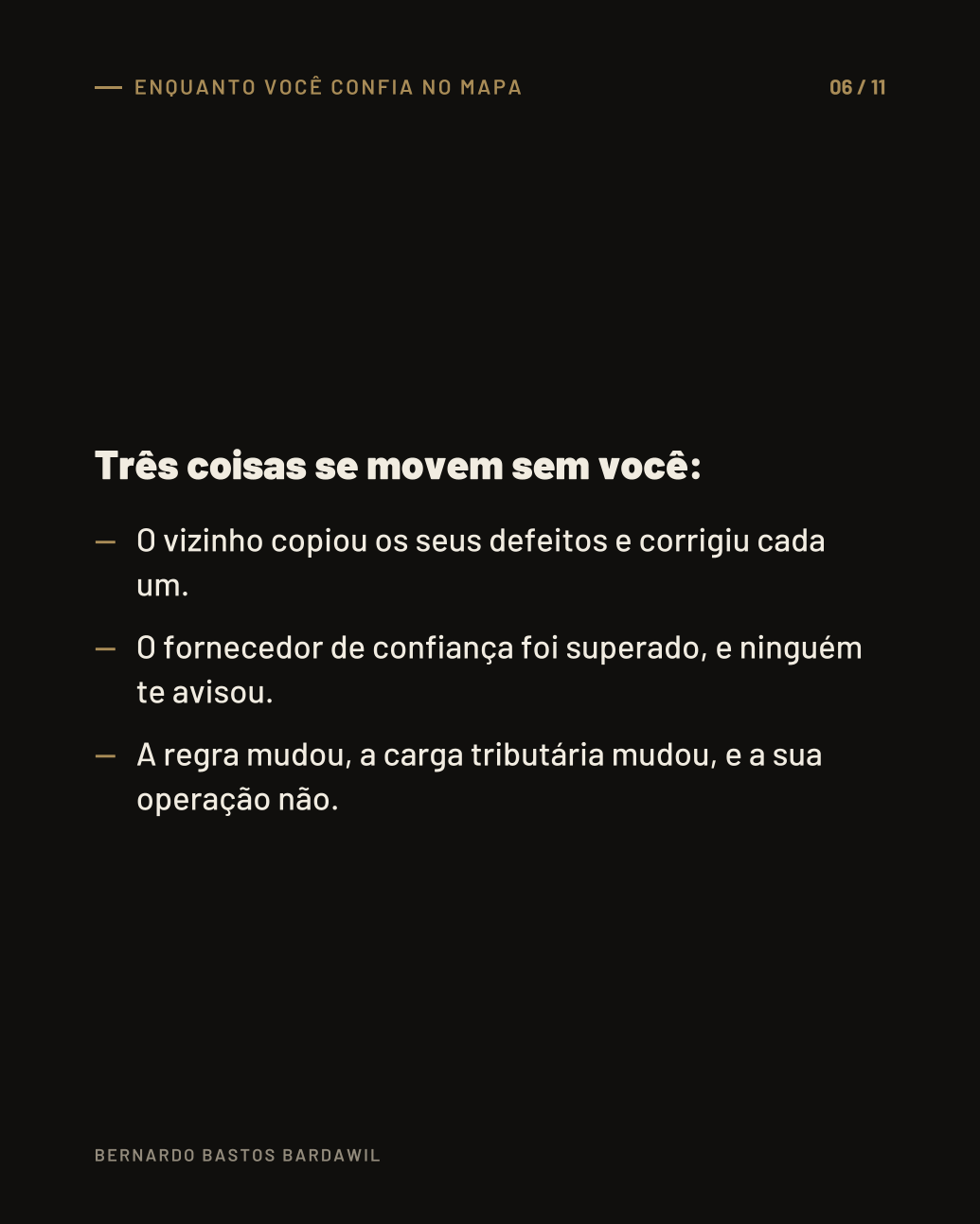
You trust the map you drew. And while you trust it:
• Your neighbor copied your flaws and fixed each one.
• Your trusted supplier was overtaken, and nobody told you.
• The rules changed, the tax burden changed, and your operation did not.

Whoever crosses time changes before the market changes for him.

Respect the market. It does not respect you.

Post page · Comment on LinkedIn

Jun 11, 2026

Yesterday I stopped my schedule to write a method that sells nothing

image 1/8image 2/8image 3/8image 4/8image 5/8image 6/8image 7/8image 8/8
1 / 8

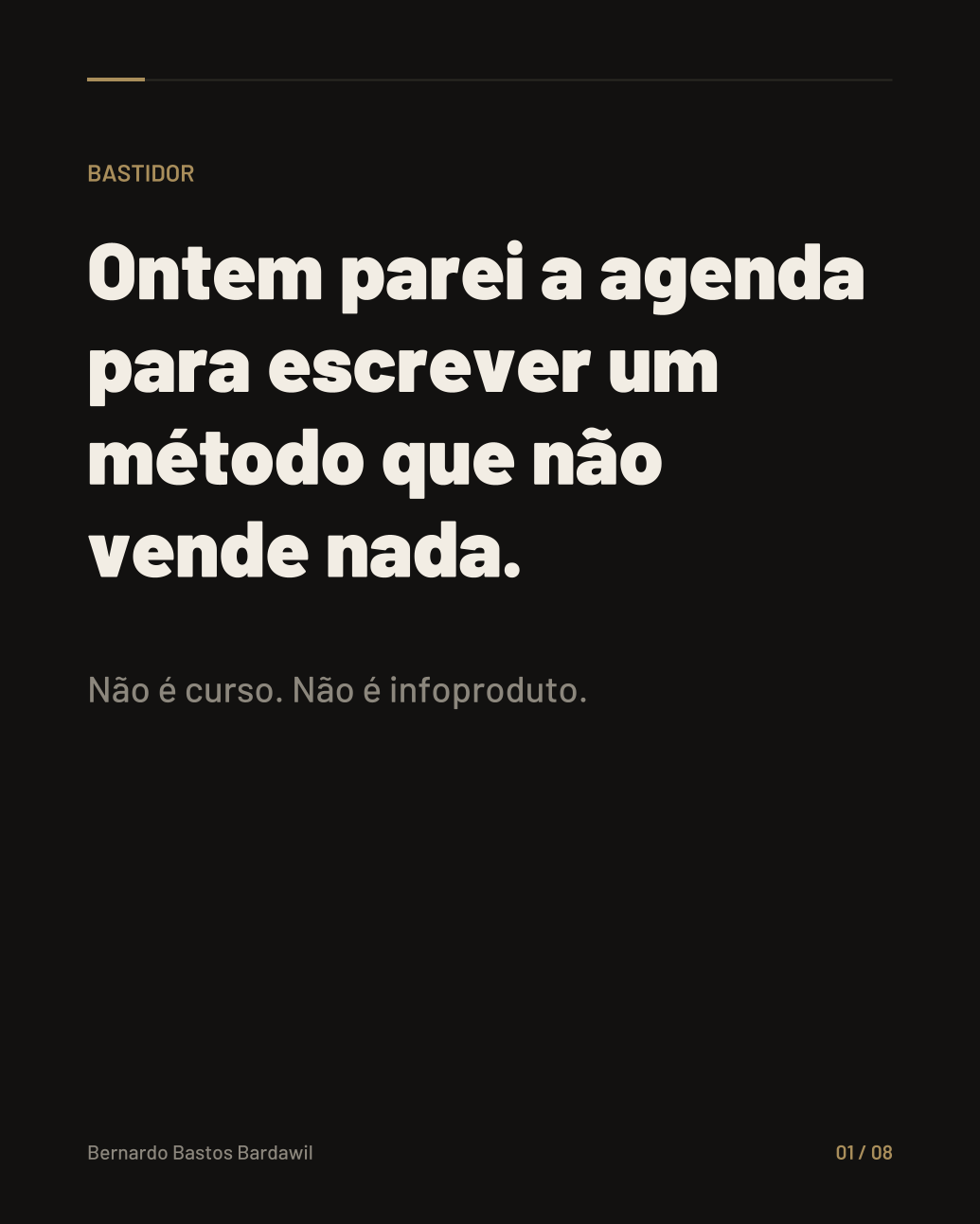
Yesterday I stopped my schedule to write a method that sells nothing.

It is not a course. It is not an info product.

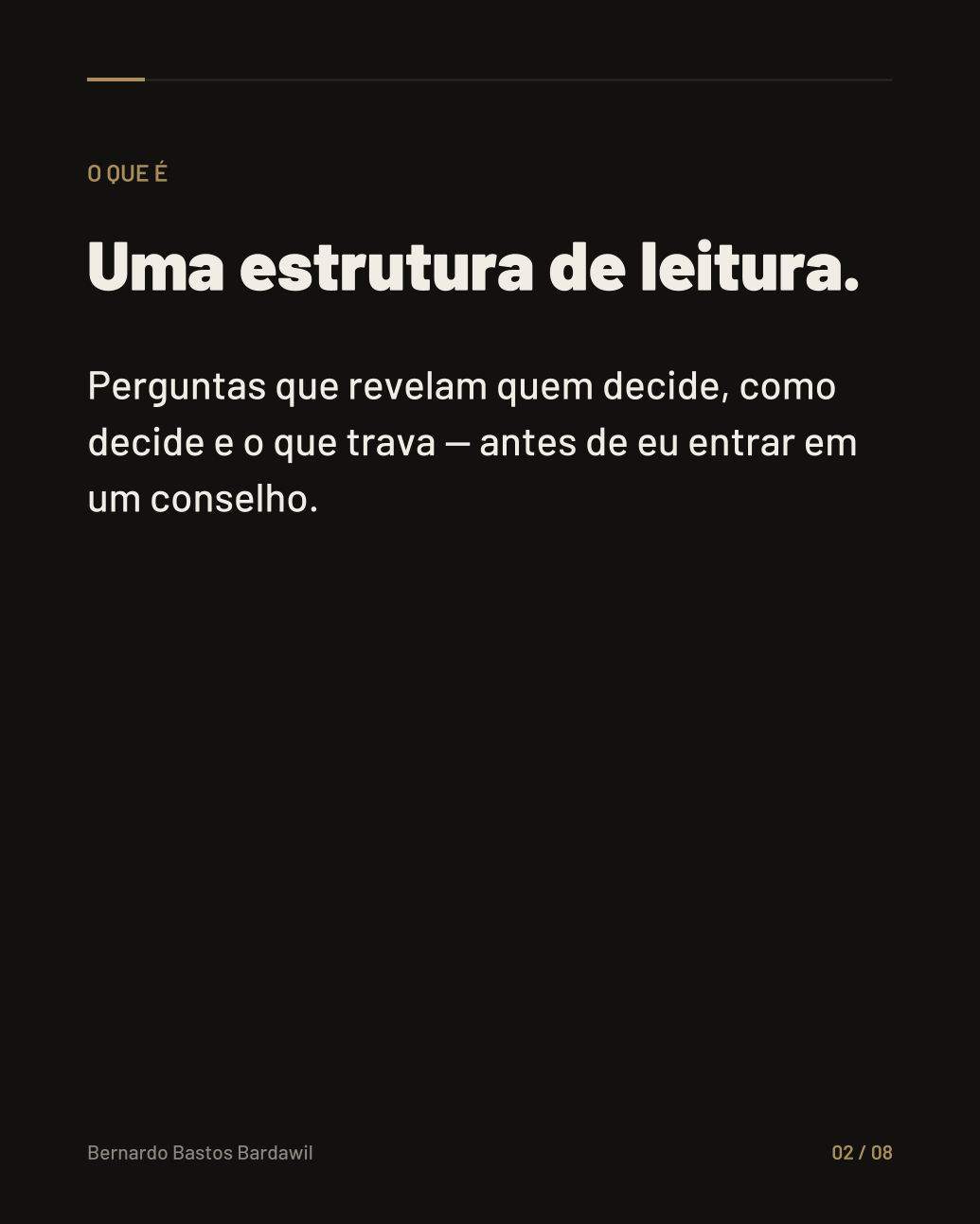
It is a reading structure: questions that reveal who decides, how they decide and what blocks them, before I join a Board.

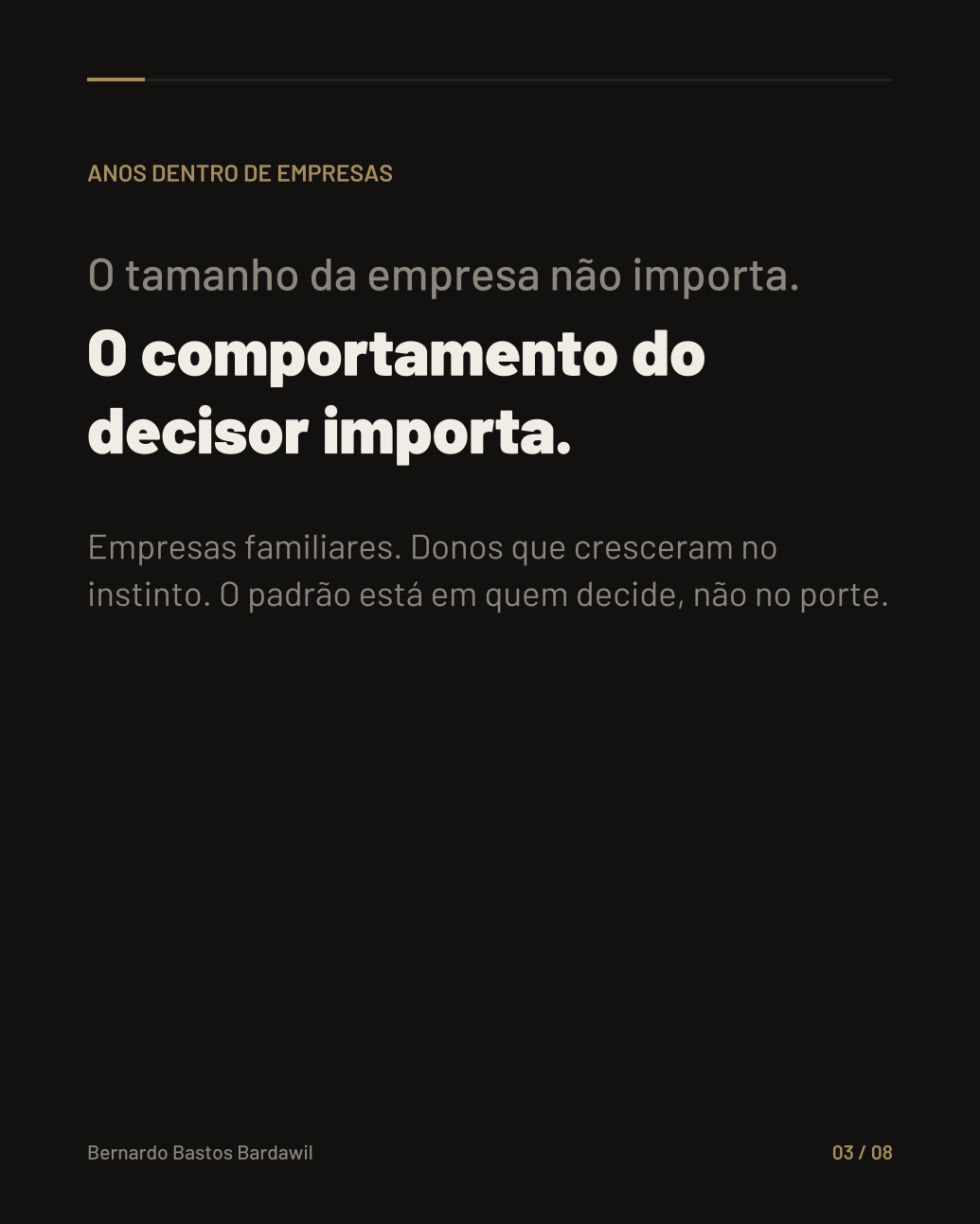
Years inside family businesses and with owners who grew on instinct taught me one thing: the size of the company does not matter. The behavior of the decision maker does.

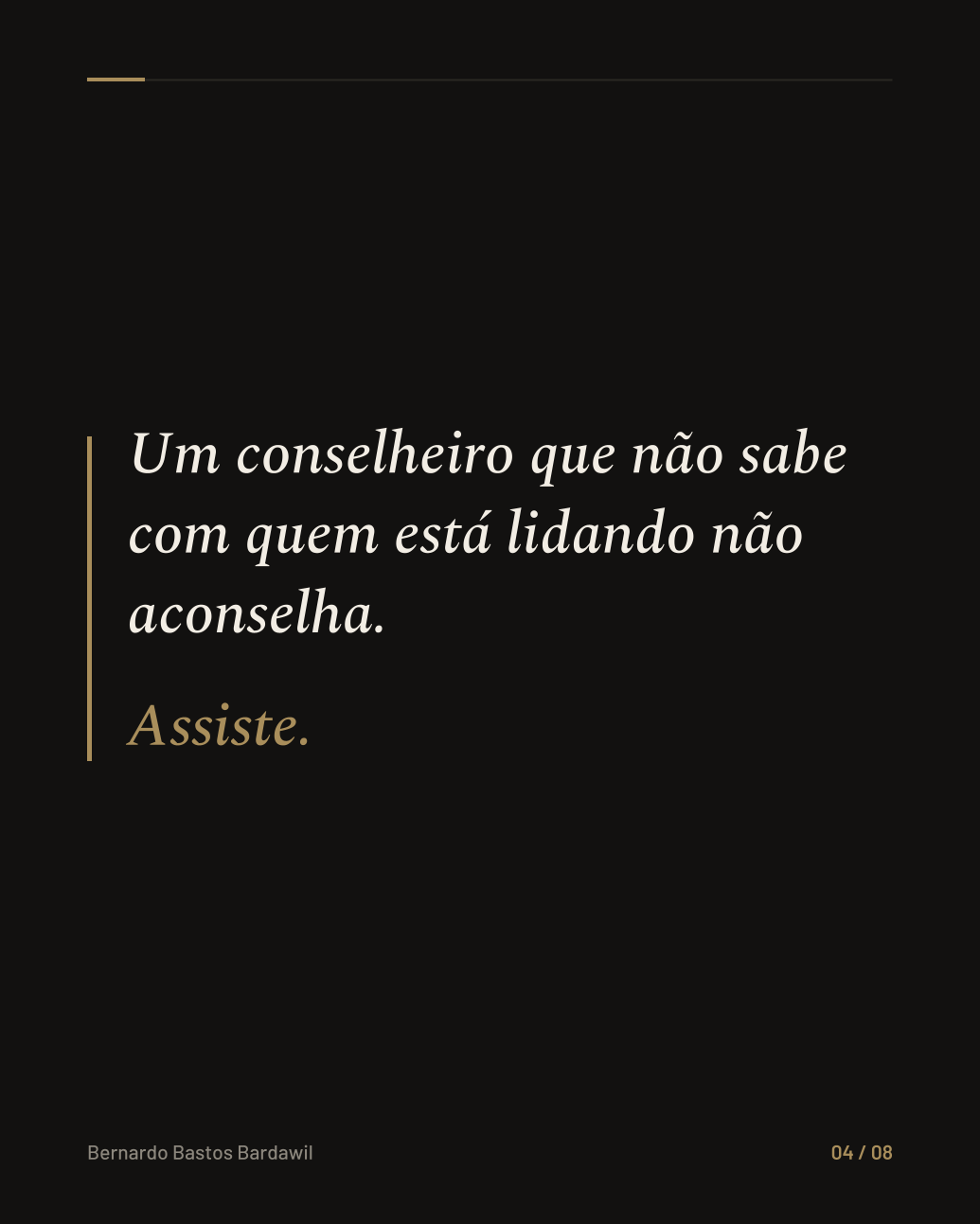
A Board member who does not know whom he is dealing with does not advise. He watches.

And writing each question, I saw the portrait of almost every owner:

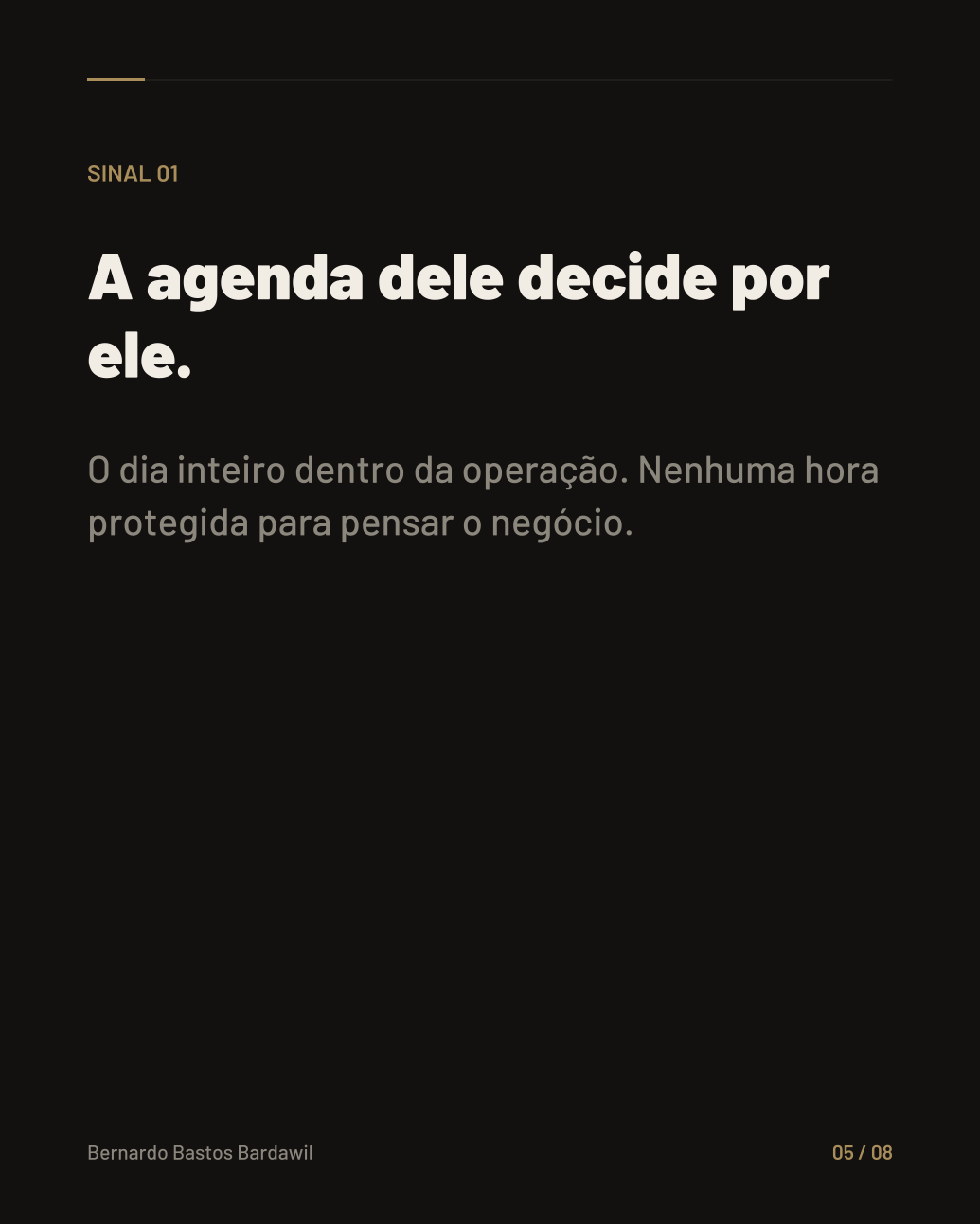
• The whole day inside the operation, not one protected hour to think about the business. His calendar decides for him.
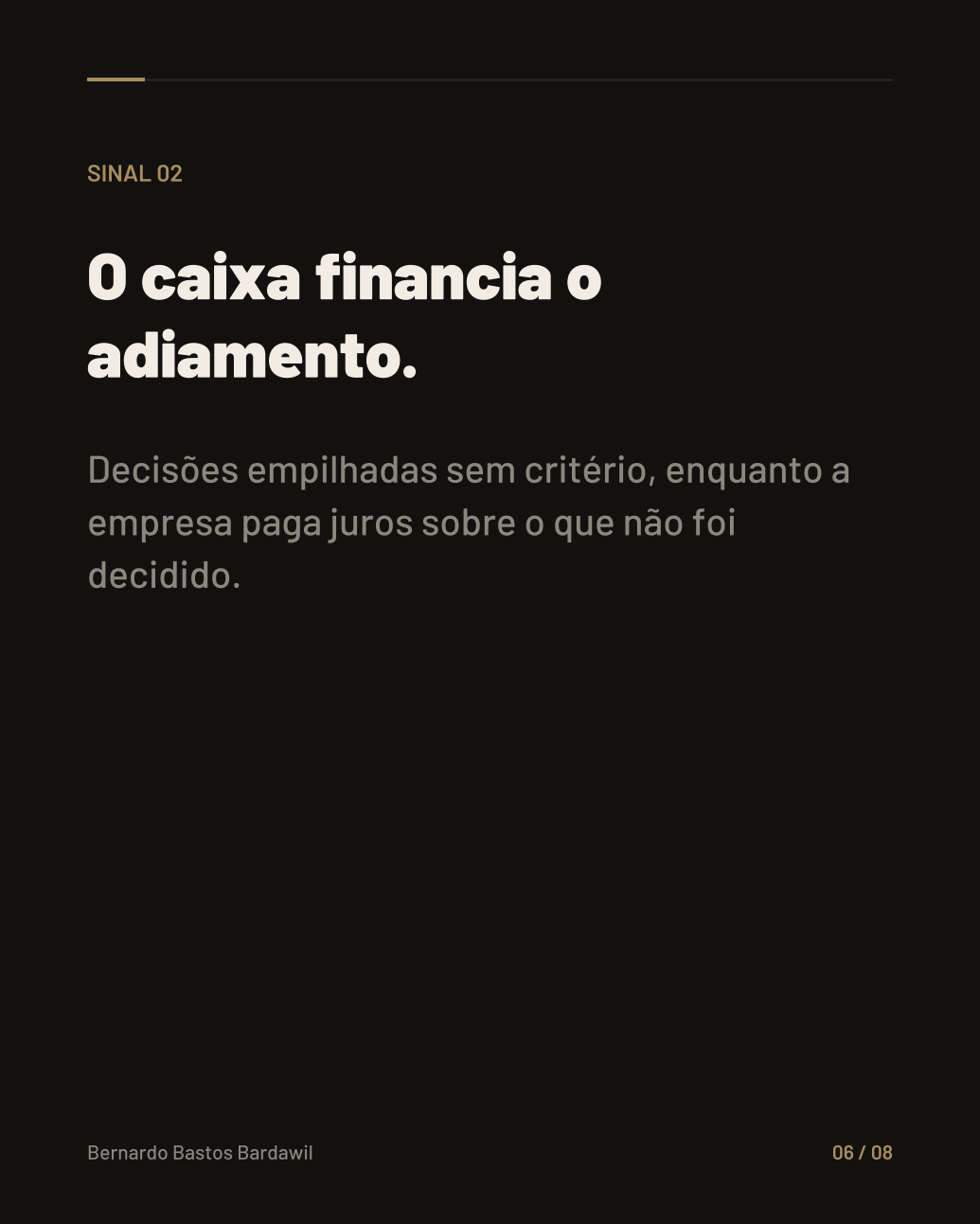
• Decisions piled up without criteria, while cash finances the postponement.
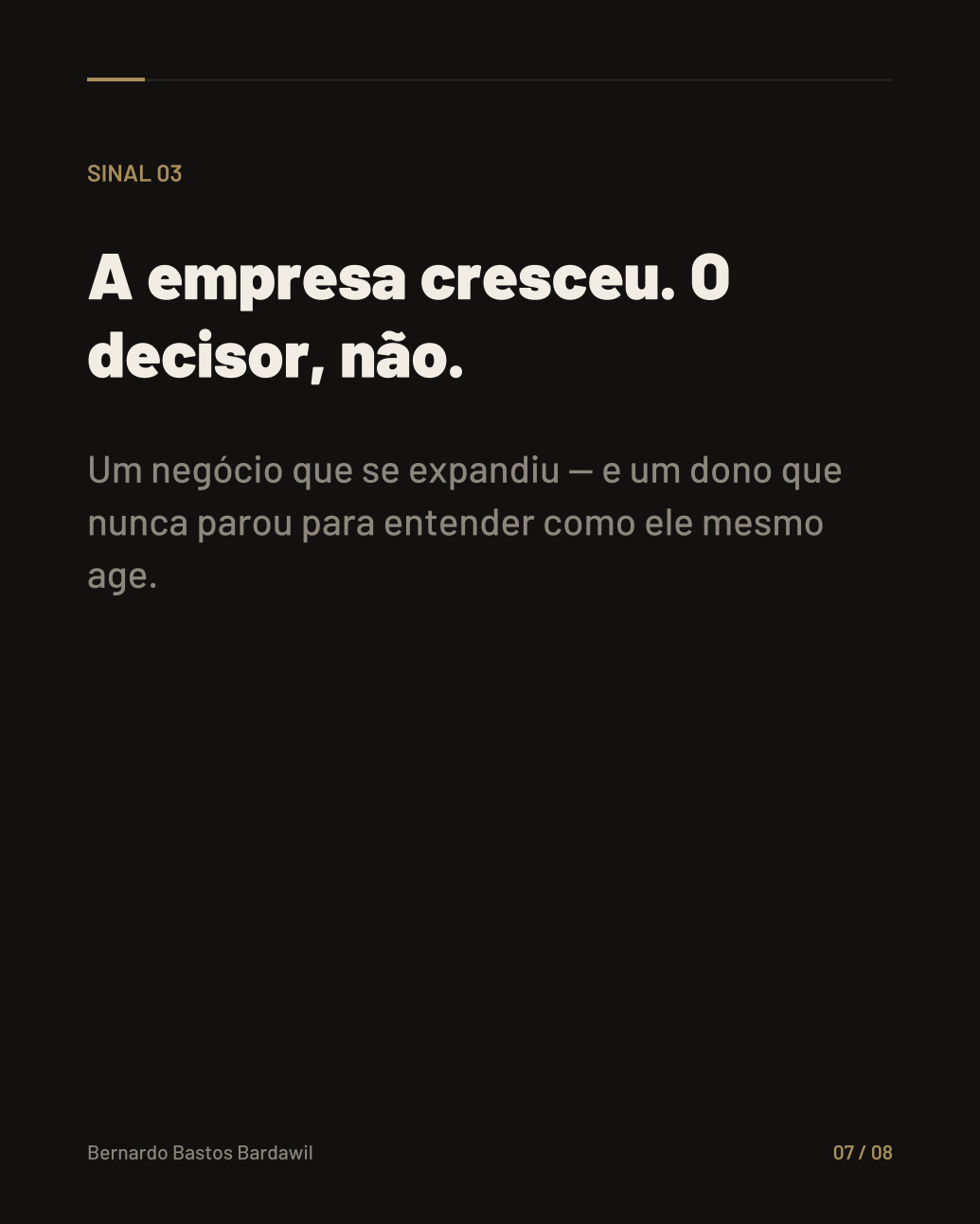
• A company that grew, and a decision maker who never stopped to understand how he himself acts.

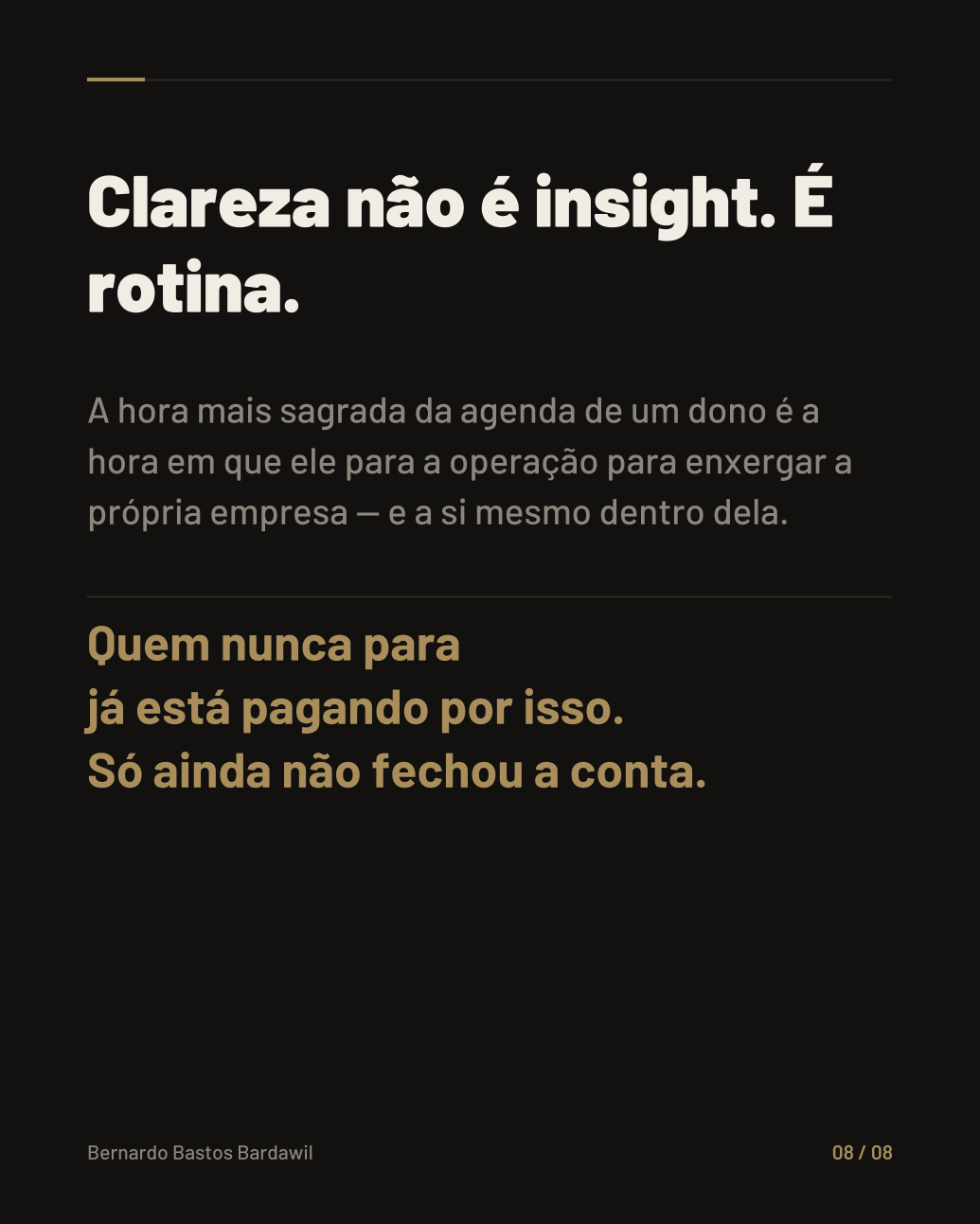
Clarity is not insight. It is routine.

The most sacred hour in an owner's calendar is not the sales meeting. It is the hour when he stops the operation to see his own company, and himself inside it.

Whoever never stops is already paying for it. He just has not closed the account yet.

Post page · Comment on LinkedIn

Did one of these posts describe your company?